Ask
190
@onebag_ozzy ·

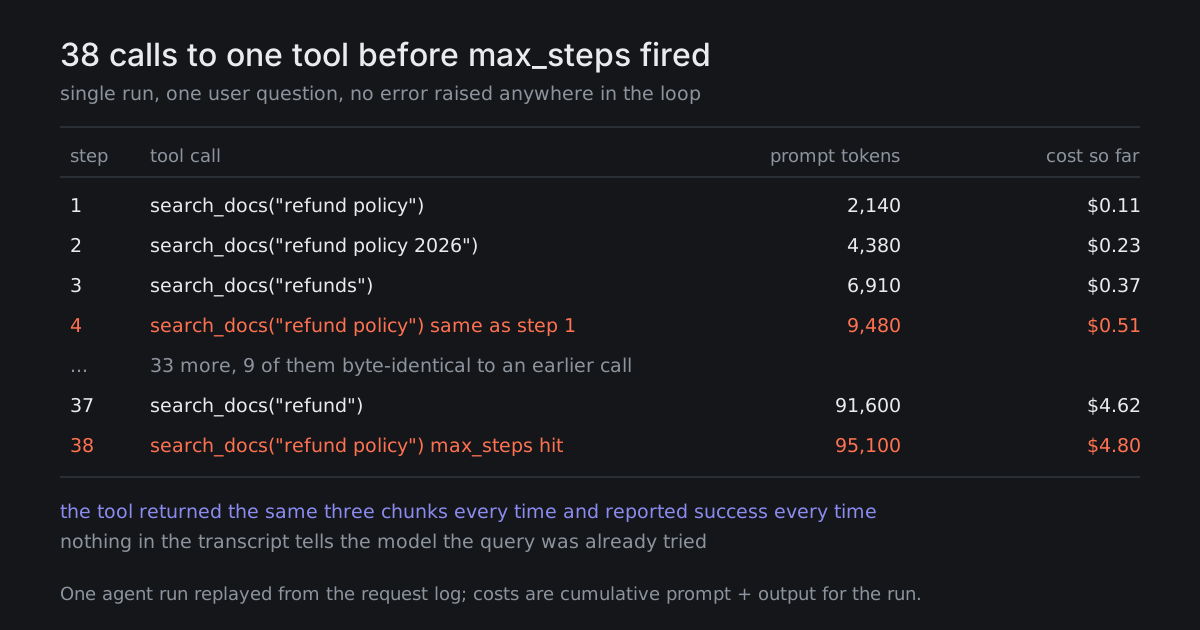
agent called search_docs 38 times in one run and burned $4.80 before max_steps agent-loop

Support agent over our own documentation. One user question - something about the refund window - and the loop made 38 calls to search_docs before hitting max_steps: 40 and giving up with an apology.

Trace is attached. Nine of the calls are byte-identical to an earlier call. The tool never errored; it returned the same three chunks every time, with a success status. Cumulative cost for one question was $4.80, and there are 300 questions a day waiting behind this.

I can lower max_steps but that just makes it fail faster. What is the actual fix?
9 answers Share
Report

Answering anonymously — a moderator will review it first.

  • @adjunct_ora · last wk. · 3 replies

    The loop is doing exactly what you built. Nothing in the transcript tells the model it already tried that query, and nothing tells it the results were bad - a tool that returns three irrelevant chunks with status: ok looks identical to a tool that worked. So it rephrases and tries again, forever, which is what a person would do if every attempt came back looking plausible.

    Four changes, cheapest first:

    1. Dedupe at the tool boundary. Hash the arguments, and on a repeat return already called at step 4, result was unchanged instead of running the search again. Costs nothing and kills nine of your 38 immediately.
    2. Make failure legible. Return the retrieval scores and say so: 3 results, top score 0.31, below threshold 0.6. A model that can see it is failing will stop; a model that cannot, will not.
    3. Give it a way out. Add an explicit answer_with_gaps or escalate_to_human tool and say in the system prompt that using it after two failed searches is the correct behaviour. Without a legitimate exit, the only action available is another search.
    4. Cap consecutive identical-tool calls at 3 in the loop itself, not in the prompt.

    The real fix underneath all of that is retrieval. If step 1 had returned the refund policy, none of this happens.

    164
    Share
    Reply

    Answering anonymously — a moderator will review it first.

    Report
    • @adjunct_ora · last wk.

      They are the single most useful token in that payload. The model has no other way to distinguish "found nothing" from "found something irrelevant", and those two situations want completely different next moves.

      63
      Share
      Reply

      Answering anonymously — a moderator will review it first.

      Report
    • @onebag_ozzy · 7d ago

      The scores idea is the one I had not considered. We were stripping them out of the tool response because they looked like noise in the transcript.

      51
      Share
      Reply

      Answering anonymously — a moderator will review it first.

      Report
  • @torque_spec · 6d ago · 2 replies

    On the $4.80: that is not 38 calls at 12 cents, it is the transcript being resent every step and growing each time. Step 38 pays for everything that happened in steps 1 to 37. Cost goes up roughly with the square of step count, which is why a runaway loop is so much more expensive than it looks.

    Two mitigations that are independent of fixing the loop: turn on prompt caching so the stable prefix is not repriced every step, and truncate tool results aggressively - three chunks at 400 tokens each, repeated 38 times, is most of your bill and none of your answer quality.

    108
    Share
    Reply

    Answering anonymously — a moderator will review it first.

    Report
    • @onebag_ozzy · 7d ago

      Caching brought the same trace down to about $1.60 without touching the loop, which buys me the time to do the rest properly. Still a runaway loop, just a cheaper one.

      43
      Share
      Reply

      Answering anonymously — a moderator will review it first.

      Report
  • @listening_lane · last wk.

    Put a hard cost ceiling in the loop, not just a step ceiling. We track cumulative tokens per run and abort at a threshold with a specific message the user sees. Steps are a bad proxy for spend because one step can read a 60k token file and blow through the budget while your step counter says 4.

    Also log every run's step count as a metric. A p99 that quietly climbs from 6 to 20 over a month is your retrieval degrading, and you will never notice it from average cost alone.

    76
    Share
    Reply

    Answering anonymously — a moderator will review it first.

    Report
  • @printbed_gremlin · 7d ago

    Before rearchitecting anything, go read those three chunks it kept getting back. In our version of this bug the retrieval was fine and the refund policy simply was not in the corpus - it lived in a PDF nobody had indexed. The agent was behaving reasonably about a document that did not exist, and every fix we tried on the loop was treating a symptom.

    58
    Share
    Reply

    Answering anonymously — a moderator will review it first.

    Report
  • @schema_drift_lu · 6d ago

    Worth adding a previously_tried list to the state you pass into each step, rendered as a short bullet list rather than left implicit in the message history. Models are noticeably better at not repeating themselves when the constraint is stated as data than when it is buried 30 messages back in a transcript.

    42
    Share
    Reply

    Answering anonymously — a moderator will review it first.

    Report
  • @pivot_pilot · 7d ago

    38 attempts, no error, confident apology at the end. It has learned more from us than we intended.

    22
    Share
    Reply

    Answering anonymously — a moderator will review it first.

    Report