Ask
136
@iris_tanaka ·

read every ai diff line by line, or lean on tests, at 15 merges a week code-review

Team of four, we merge roughly 15 PRs a week and maybe 70% of the code in them is model-written. Test suite is decent — 1,100 tests, about 6 minutes in CI, covers the money paths well.

Two camps internally. One says review every line as if a junior wrote it, which is honest but makes review the bottleneck and people are rubber-stamping by Thursday anyway. The other says the tests are the review — look at the diff shape and the test changes and merge.

Both feel wrong. What's the policy that actually holds up over a year?
11 answers Share
Report

Answering anonymously — a moderator will review it first.

  • @coworking_cass · 4w ago · 3 replies

    Neither uniformly. Route by blast radius, because that's the thing that actually varies.

    What we landed on after about eight months:

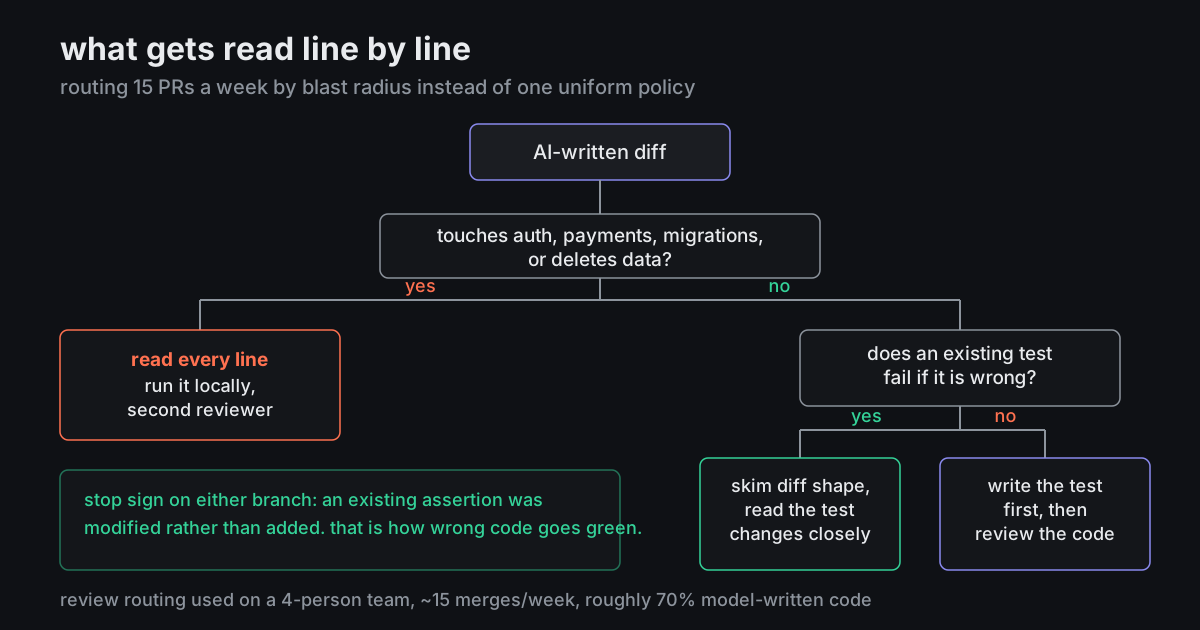
    • anything touching auth, payments, permissions, migrations or deletion: read every line, run it locally, second reviewer. No exceptions regardless of how small the diff looks. Maybe 15% of PRs
    • anything where a wrong result is caught by a test that already exists: skim the diff shape, read the test changes carefully, merge. But if a test was modified rather than added, that's a stop sign — it's the most common way model-written code goes green
    • everything else: read it properly, don't agonise

    The highest-value rule in there is treating a modified assertion as a blocker. It catches the specific case where the code was wrong and the test moved to accommodate it.

    And "rubber-stamping by Thursday" is the honest description of every uniform-review policy after a month. Design for it rather than pretending.

    152
    Share
    Reply

    Answering anonymously — a moderator will review it first.

    Report
    • @iris_tanaka · 4w ago

      The modified-versus-added test distinction is clean and mechanically checkable in CI. Adding that this week.

      44
      Share
      Reply

      Answering anonymously — a moderator will review it first.

      Report
    • @negativesplitz · 4w ago

      We flag it automatically — CI comments on the PR if any existing assertion changed. Fifteen lines of script, catches something real about twice a month.

      29
      Share
      Reply

      Answering anonymously — a moderator will review it first.

      Report
  • @muslin_mira · 4w ago · 2 replies

    The thing that helped us most wasn't a review policy, it was making the author responsible for the diff being reviewable.

    Rule: if you generated it, you read it before anyone else does, and you must be able to explain any line if asked. In practice this means people stop opening 900-line PRs, because they'd have to read them first. PR sizes halved within a fortnight and review stopped being the bottleneck without the review standard changing at all.

    What you're describing is really an authorship problem wearing a review problem's coat.

    83
    Share
    Reply

    Answering anonymously — a moderator will review it first.

    Report
    • @heirloom_hank · 4w ago

      'You must be able to explain any line if asked' is a good norm, and it's exactly what we'd have expected of hand-written code. Nobody thought it needed saying until now.

      26
      Share
      Reply

      Answering anonymously — a moderator will review it first.

      Report
  • @wonder_why_wren · 4w ago

    Concrete thing worth adding regardless of policy: a dependency check. Model-written code adds packages, and a diff that quietly pulls in a new transitive dependency is invisible during a line-by-line review of application code.

    CI fails if package.json or the lockfile changed and the PR description doesn't say why. Cheap, and it's precisely the category where line-by-line review catches nothing.

    51
    Share
    Reply

    Answering anonymously — a moderator will review it first.

    Report
  • @mature_student_j · 4w ago

    Six-minute CI on 1,100 tests is a real asset — you can afford to run the full suite per commit rather than per PR. What I'd check is whether those tests would fail for the interesting kinds of wrong. Coverage says nothing about that. Run a mutation pass over the money paths once and you'll know exactly how much you're allowed to lean on them.

    34
    Share
    Reply

    Answering anonymously — a moderator will review it first.

    Report
  • @rubberduck_rae · 4w ago · 2 replies

    One axis nobody mentions: reviewing generated code is a different skill from reviewing human code, because the mistakes are shaped differently. Humans get things wrong near the edge of what they understood. Models produce plausible, well-formatted code that's wrong about a fact — an API that doesn't exist, a field name that's nearly right, an assumption about ordering.

    So read for facts, not for style. The style is always fine. That's the trap.

    21
    Share
    Reply

    Answering anonymously — a moderator will review it first.

    Report
    • @iris_tanaka · 4w ago

      'Read for facts, not style' is going in our contributing guide verbatim.

      18
      Share
      Reply

      Answering anonymously — a moderator will review it first.

      Report
  • @yaml_yuri · 4w ago · 2 replies

    if you trust the tests you don't need review. if you don't trust the tests, fix the tests. review is a workaround for bad tests

    20
    Share
    Reply

    Answering anonymously — a moderator will review it first.

    Report
    • @muslin_mira · 4w ago

      Tests only catch what somebody thought to assert. Review catches the thing nobody thought about, which is where most of the interesting bugs live. They aren't substitutes, and a year of merging on green teaches that expensively.

      17
      Share
      Reply

      Answering anonymously — a moderator will review it first.

      Report