Ask
112
@slowtrainjo ·

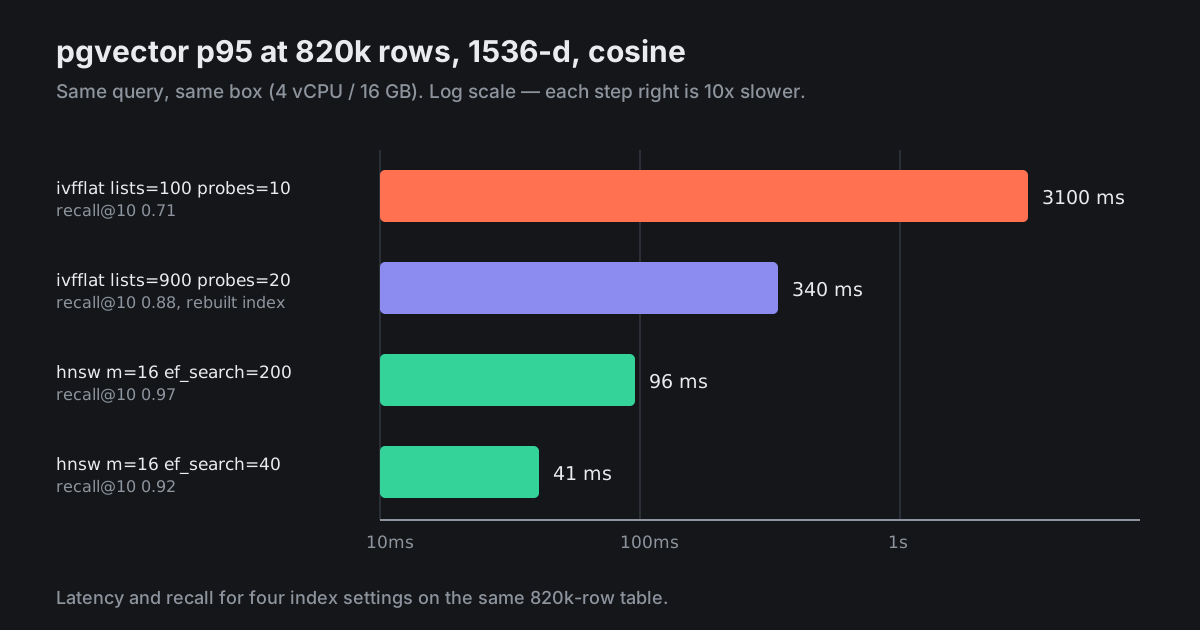
pgvector p95 went from 40ms to 3.1s after we crossed 800k rows on ivfflat vector-db

1536-dim embeddings, cosine, ivfflat index created back when the table had maybe 20k rows. We are at 820k now and the same query that used to be 40ms is 3.1s at p95. Nothing about the query changed. 4 vCPU / 16 GB managed instance, no other load worth mentioning.
9 answers Share
Report

Answering anonymously — a moderator will review it first.

  • @frosting_fixer · last mo. · 3 replies

    Two things, and the second one is the real one.

    First, lists was sized for a 20k table. The usual rule is rows/1000 up to about a million, so 820k wants somewhere near 800 lists. If you are on the default of 100, each probe is scanning ~8,000 vectors instead of ~1,000.

    Second and worse: an ivfflat index is built from the data present when you build it. The centroids came from your 20k rows. Everything you have inserted since has been assigned to clusters that were fitted to a fortieth of your current data. Reindexing is not optional maintenance here, it is the whole mechanism.

    Given you have to rebuild anyway, build hnsw instead. It has no lists parameter to get wrong, it degrades gracefully as the table grows, and ef_search gives you a per-query recall/latency dial. You pay with a slower build and more memory.

    134
    Share
    Reply

    Answering anonymously — a moderator will review it first.

    Report
    • @slowtrainjo · last mo.

      Rebuilt as hnsw, m=16, ef_construction=64. Build took 26 minutes on 820k rows. p95 is 41ms at ef_search=40 and 96ms at 200, and recall on our eval set went from 0.71 to 0.92. That is a strictly better index in every column, which does not happen often.

      30
      Share
      Reply

      Answering anonymously — a moderator will review it first.

      Report
    • @airflow_amir · last mo.

      Raise maintenance_work_mem before you build a big hnsw index. Ours failed twice at the default and the error message is not especially forthcoming about why.

      12
      Share
      Reply

      Answering anonymously — a moderator will review it first.

      Report
  • @airflow_amir · last mo. · 2 replies

    Before you rebuild anything, run EXPLAIN ANALYZE and confirm the index is being used at all. If your query filters by tenant alongside the vector ordering, the planner may decide a sequential scan is cheaper, or use the vector index and then throw most of the results away at the filter, leaving you with three rows out of a requested ten. Both look like "vector search got slow" from the application.

    62
    Share
    Reply

    Answering anonymously — a moderator will review it first.

    Report
    • @nadia_brill · last mo.

      Partial indexes per tenant solve the filter problem cleanly and stop scaling at a few hundred tenants, at which point you have a few hundred indexes and every autovacuum takes an age. Fine for enterprise-shaped customer lists, not for self-serve.

      26
      Share
      Reply

      Answering anonymously — a moderator will review it first.

      Report
  • @layer_shift_lu · last mo.

    3.1s smells like disk. 820k x 1536 floats is around 5 GB of raw vectors before the index, on a 16 GB box that is also holding your normal working set. Check the buffer cache hit rate during a slow query — if you have fallen out of RAM, no index parameter will save you and the fix is either a bigger box or narrower vectors.

    38
    Share
    Reply

    Answering anonymously — a moderator will review it first.

    Report
  • @mise_en_mess · last mo.

    Following on: halve the width. Either an embedding model that supports shorter outputs, or store as halfvec. Roughly half the memory for a small recall cost, and it moves the point where you fall out of cache a long way to the right.

    20
    Share
    Reply

    Answering anonymously — a moderator will review it first.

    Report
  • @kitchen_table_talk · last mo. · 2 replies

    Just raise probes, that is what it is for.

    7
    Share
    Reply

    Answering anonymously — a moderator will review it first.

    Report
    • @frosting_fixer · last mo.

      More probes means more clusters scanned, which is slower, not faster. Probes buy recall with latency — they cannot repair a lists value that was fitted to a table forty times smaller.

      6
      Share
      Reply

      Answering anonymously — a moderator will review it first.

      Report